By Tiago Strammiello & Caleo Tsiapalis, Co-Founders, ClaireAI
In brief
- One caller placed 1,000 real calls to personal injury firms in 25 cities and 17 states between February 16 and 22, 2026. Every call went out after 5pm local time.
- 40.9% of firms did not provide a live answer; Friday was the lowest-answer day, with about 45% of firms answering.
- Of the firms advertising 24-hour availability, 29.2% failed to answer the phone.
- 2.9% of firms had an AI-answering system observed during the study call, and 1 of the 29 systems met this study's predefined functional criteria.
The Call
February 20, 2026 — 7:42pm EST
A car runs a red light at 9pm on a Friday, someone is hurt. They're sitting in the back of an ambulance, or in a rideshare heading home from the ER, or standing on the shoulder of a highway waiting for a tow truck. They're scared and in pain. They do what almost everyone would do — they pick up their phone and search for a lawyer.
They find one, the Google listing says "Open 24 Hours." They tap the number. The phone rings and rings and rings. Nobody picks up, No voicemail, No answering service, Nothing.
So they call the next one, and the next one. Somewhere down the list, someone finally answers — and that firm gets the case, the fee, and a potential client for life.
The difference between the firm that wins that case and the firm that never knew the call happened isn't reputation, case results, or marketing spend. It's whether someone picked up the phone.
That gap — the distance between when someone needs help and when a firm actually responds — is what this study measures.
Between February 16 and February 22, 2026, we placed 1,000 live phone calls to personal injury law firms across 25 cities and 17 states. Every call went out after 5pm local time. We weren't selling anything. We weren't mystery shopping for a competitor. We asked one simple question: if someone gets hurt tonight, who picks up the phone?
The results raise practical questions for any firm that promotes after-hours availability.
This report is what we found.
About This Study
This study measures after-hours phone responsiveness among the sampled personal injury law firms.
For personal injury attorneys, intake begins when someone decides to call. This study examines whether a caller in the sample received a live answer after business hours.
This study set out to answer that question.
The Calls
- What: 1,000 personal injury law firms selected via Google Search across major and mid-size markets.
- When: February 16–22, 2026. All calls placed after 5pm local time on weekday evenings and weekends.
- Where: 17 states and 25 cities, from New York to Los Angeles, Miami to Chicago, Houston to Phoenix.
Criteria
- Answered: A live human, answering service, or receptionist picked up the call.
- Unanswered: Voicemail, endless ringing, dead line, or disconnected number. No live response.
- AI Response: An automated system, chatbot, or AI-powered agent responded to the call.
Every data point in this report represents a real call to a real firm. Not a survey. Not self-reported data. This is what a potential client actually experiences when they search for a personal injury attorney after hours and dial the number.
Study Breakdown
41%
No live answer during the study call
80%
Hang up on voicemail and never call back
2.8%
AI response rate
74%
Claim 24-hour availability
29.2%
Of 24-hour claims broke the promise
45%
Friday answer rate — the worst day
Operational Performance.The observed no-live-answer outcomes occurred in every sampled region. Because the study is not a probability sample, its results describe these calls rather than a national prevalence estimate.
Geographic Reach
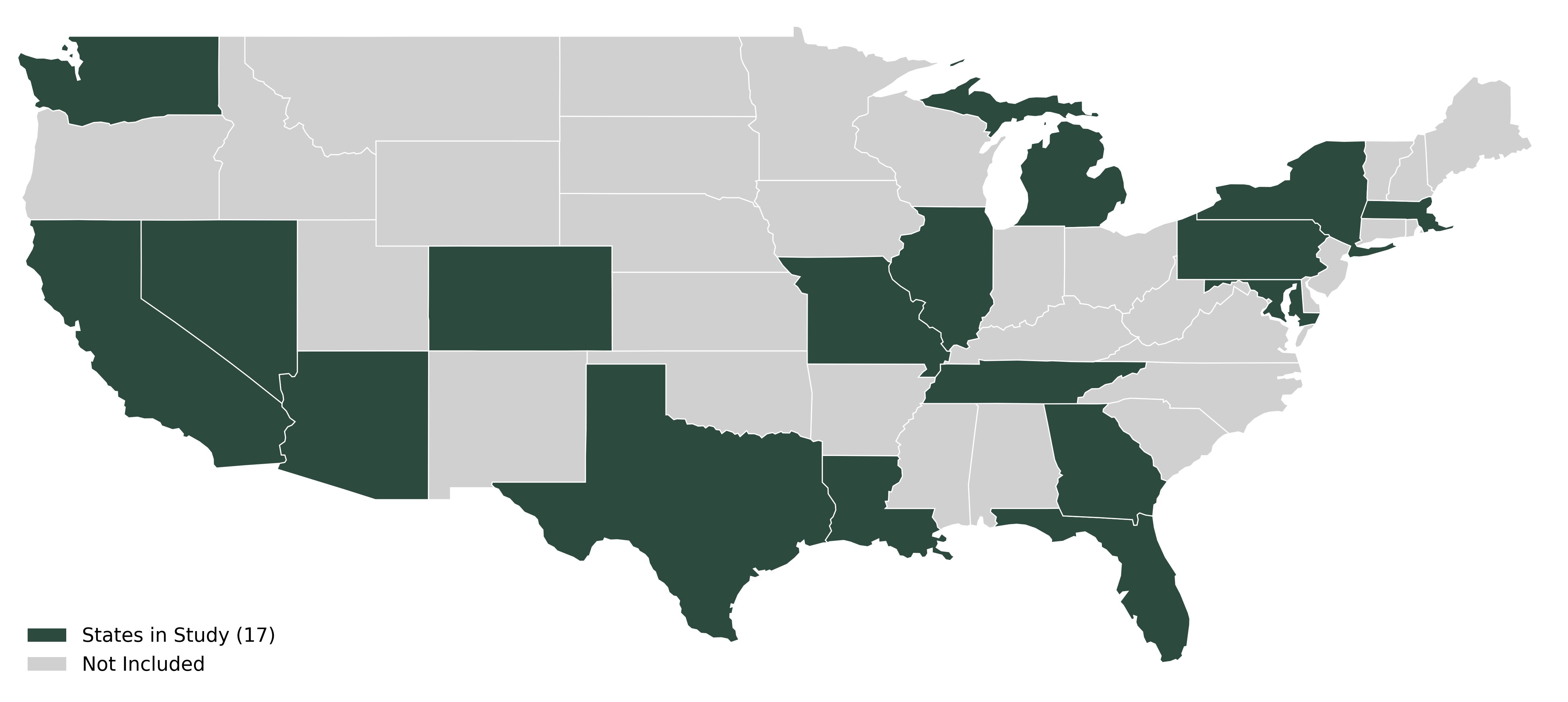
We called firms across 17 states and 25 cities—from New York to Los Angeles, Miami to Chicago. Answer rates varied across the sampled markets, and every sampled region included calls with no live answer.
| City | State | Calls Placed | Answer Rate |
|---|---|---|---|
| Las Vegas | NV | 92 | 71.7% |
| New York | NY | 75 | 78.7% |
| Chicago | IL | 71 | 53.5% |
| Denver | CO | 65 | 52.3% |
| Boston | MA | 62 | 51.6% |
| Orlando | FL | 53 | 52.8% |
| Detroit | MI | 52 | 36.5% |
| Los Angeles | CA | 48 | 56.2% |
| Memphis | TN | 46 | 39.1% |
| Miami | FL | 45 | 57.8% |
| Seattle | WA | 45 | 55.6% |
| St. Louis | MO | 41 | 41.5% |
| Philadelphia | PA | 35 | 62.9% |
| Phoenix | AZ | 35 | 57.1% |
| Baltimore | MD | 33 | 66.7% |
| Atlanta | GA | 32 | 56.2% |
| Dallas | TX | 29 | 51.7% |
| Pittsburgh | PA | 29 | 62.1% |
| New Orleans | LA | 28 | 53.6% |
| Palo Alto | CA | 23 | 43.5% |
| San Francisco | CA | 21 | 57.1% |
| Nashville | TN | 11 | 45.5% |
| Houston | TX | 10 | 70.0% |
| San Diego | CA | 10 | 70.0% |
| San Antonio | TX | 9 | 100.0% |
Descriptive answer rates from 1,000 calls placed after 5pm local time, February 16–22, 2026. Small city samples should not be read as market rankings.
Across the Sampled Regions
Regional Answer Rates by Area
Descriptive answer rates varied across cities and regions. No sampled region's aggregate answer rate exceeded 80%; even the Northeast aggregate left more than one in five study calls without a live answer.
| Region | Share of Calls | Answer Rate |
|---|---|---|
| West | 37.8% | 59.7% |
| Northeast | 23.3% | 65.7% |
| Southeast | 22.5% | 51.7% |
| Midwest | 16.4% | 44.6% |
Why It Matters
A missed call after hours is not just a lost lead. It's a cascade of consequences.
When someone calls a law firm at 9pm after getting rear-ended on the highway, they are not comparison shopping. They are scared. They are hurt. The clock on their case is already ticking whether anyone picks up or not.
The Crash-Timing Paradox
National Safety Council data shows that fatal crashes were more frequent on weekends and peaked on Saturday in 2024, while nonfatal crashes peaked on Friday. In our study, Friday had the lowest answer rate of any day at 45%. The two datasets measure different things, but together they make Friday evening an operational window worth testing.
The Voicemail Dead End
A voicemail-only path gives an urgent caller no live answer and may leave the firm with no usable intake record. This study did not measure what a caller did after reaching voicemail, so it does not claim a universal voicemail abandonment rate.
Evidence Disappears
Some evidence can be time-sensitive: businesses may overwrite surveillance video, vehicles may overwrite telemetry, and witnesses can become harder to reach. Retention periods vary materially by system, jurisdiction, and the facts of a matter, so this report does not assign a universal deadline or say that a delay determines the outcome of a case.
The Five-Minute Window
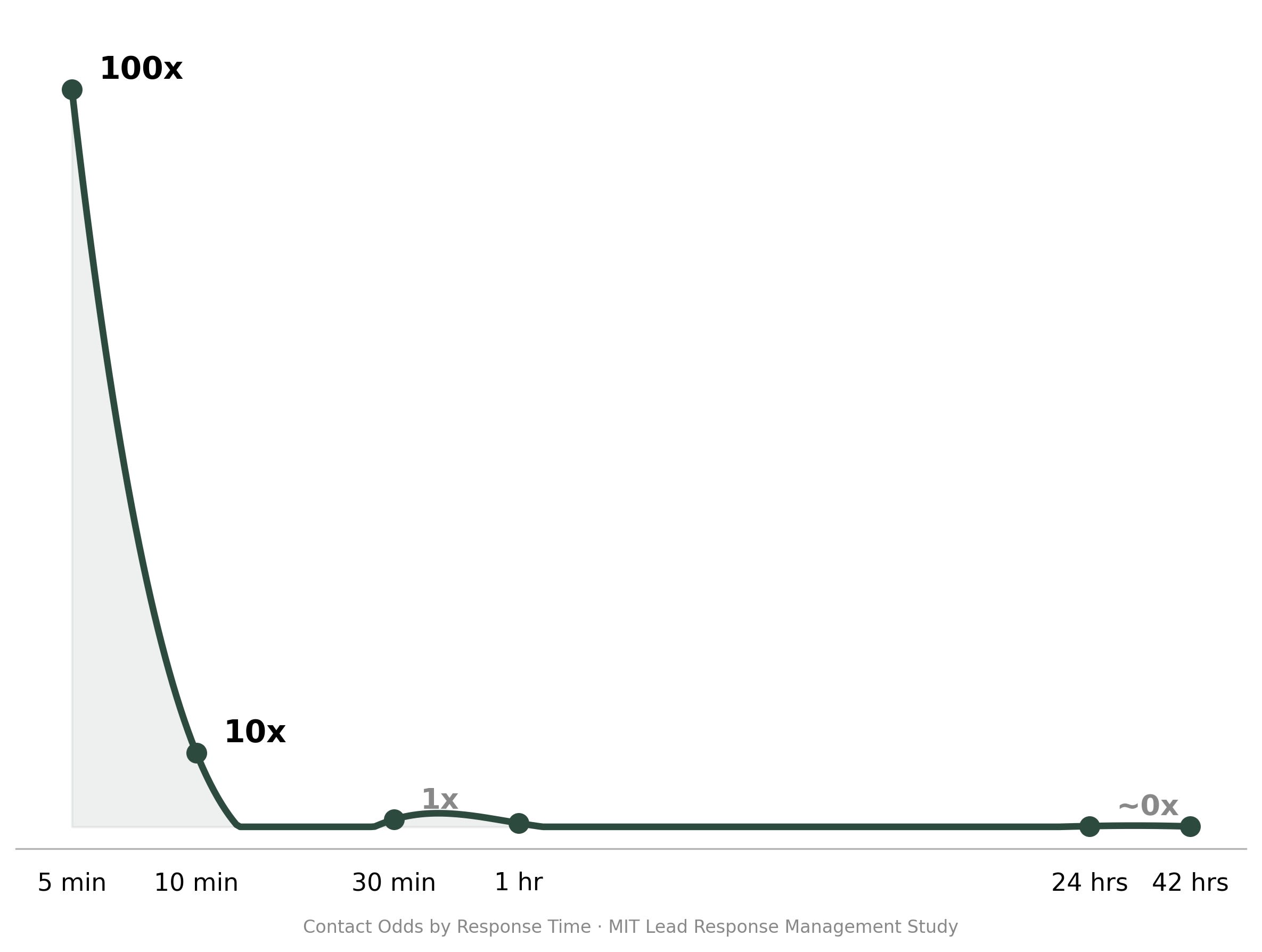
Martindale-Avvo's 2023 consumer report says that more than 80% of respondents would contact another attorney after 48 hours without a reply. In a separate online-sales study, Oldroyd's Lead Response Management research reported 100× higher odds of making contact and 21× higher odds of qualification for a contact attempt within five minutes versus 30 minutes. Those results are not a personal-injury conversion forecast, but they support treating response time as an intake-control metric.
By The Time They Call
They've already decided.
FindLaw's Consumer Legal Needs Survey reported that 87% of consumers who contacted an attorney went on to hire one, and 64% of that group contacted only one attorney. The survey is older and not personal-injury-specific, but it is a direct source for those two figures.
Martindale-Avvo's 2023 report separately found that more than 80% of consumers would contact another attorney after 48 hours without hearing back. The page previously attributed a 78% 'first responder wins' figure to a publisher whose study is no longer publicly available; that unsupported statistic has been removed.
87%
Hire after contacting an attorney
64%
Of that group, contact only one attorney
80%+
Would contact another attorney after 48 hours without a reply
What a Missed Call Actually Costs
| Financial Metric | Value | Source |
|---|---|---|
| Google Ads cost per click | $70–$250 | National Law Review (vendor-contributed analysis, 2025) |
| Cost per lead | $700–$1,500 | National Law Review (vendor-contributed analysis, 2025) |
| Cost per signed case | $2,500–$3,000 | National Law Review (vendor-contributed analysis, 2025) |
The Cost of 409 Unanswered Calls
| Illustrative answer-rate scenario | Potential live conversations from 409 unanswered calls |
|---|---|
| 10% become viable conversations | 41 |
| 25% become viable conversations | 102 |
| 50% become viable conversations | 205 |
Illustrative only. This is not a revenue forecast: a firm should apply its own qualification rate, signed-case rate, case mix, fee agreement, and contribution margin.
409
Calls in this study with no live answer
$70–$250
PPC cost-per-click range in one 2025 vendor analysis
$700–$1,500
PPC cost-per-lead range in that analysis
A generic settlement value cannot responsibly predict a firm's lost fee revenue. The decision-grade calculation is firm-specific: missed live-intake opportunities × the firm's own qualification and signed-case rates × actual contribution margin.
The Speed-to-Retention Clock
Oldroyd's Lead Response Management Study, Harvard Business Review, and Velocify's sales-optimization study each studied online sales leads rather than personal-injury intake. They support a direction of effect—faster follow-up is associated with better contact or conversion outcomes—not a law-firm-specific causal forecast.
The Oldroyd study reported 100× higher contact odds and 21× higher qualification odds for an attempt within five minutes versus 30 minutes. The historical HBR research reported a 42-hour average first-response time among companies that responded within a month, while nearly one quarter took more than 24 hours. A later Velocify study used almost 3.5 million leads from more than 400 clients and reported a 391% conversion improvement for a call attempt within one minute. These are historical, cross-industry vendor and business-publication findings; they should be used as operating context, not as a promise of a particular result.
| Finding | Data | Sample Size | Year | Source |
|---|---|---|---|---|
| Contact odds | 100× higher within 5 min vs. 30 min | Not stated in the surviving public publisher copy | 2007 | Oldroyd / InsideSales report |
| Qualification odds | 21× higher within 5 min vs. 30 min | Not stated in the surviving public publisher copy | 2007 | Oldroyd / InsideSales report |
| Average first response | 42 hours among companies responding within a month | Not stated in the publisher's 2014 summary | 2011 | HBR research, summarized by InsideSales |
| Slow response | Nearly 24% took more than 24 hours | Not stated in the publisher's 2014 summary | 2011 | HBR research, summarized by InsideSales |
| Call within one minute | 391% conversion improvement | Almost 3.5M leads; 400+ client firms | 2012 | Velocify sales-optimization study |
| Legal consumer follow-up | 80%+ would contact another attorney after 48 hours without a reply | Consumer survey | 2023 | Martindale-Avvo consumer report |
“The cited research supports fast follow-up as an operating discipline. It does not establish a universal response-time threshold or predict a personal-injury firm's signed-case results.”
Client Impact
The results document a gap in this sample between some firms' stated 24-hour availability and the live-answer experience of the study caller.
| 2024 road-safety finding | What the source says | Source |
|---|---|---|
| Alcohol-impaired crash deaths | 11,904 people were killed in alcohol-impaired crashes. | National Safety Council |
| Nighttime concentration | About 69% of alcohol-impaired crashes occurred at night. | National Safety Council |
| Fatal crash timing | Fatal crashes were more frequent on weekends and peaked on Saturday. | National Safety Council |
| Nonfatal crash timing | Nonfatal crashes peaked on Friday. | National Safety Council |
These national road-safety figures provide context only; they do not measure personal-injury law-firm demand or case value.
The End-of-Week Drop Off
Friday was the worst day in the study. Not by a little — by a lot. Only 45% of firms answered, which means 60 out of 110 calls went nowhere. No human, no AI, no answering service. Just ringing.
Thursday wasn't far behind at 52.6%. So the two worst-performing days in the entire dataset are back-to-back — the tail end of the workweek, when you'd think coverage would still be in place. Staff were on the hours earlier. Phones were working all day. Then 5pm hits and apparently everyone just leaves. Monday led all days at 70.0%. Tuesday held at 66.0%. Something breaks between Tuesday and Thursday, and by Friday it's gone.
National Safety Council data shows that fatal crashes were more frequent on weekends and peaked on Saturday in 2024, while nonfatal crashes peaked on Friday. That does not prove that an unanswered call would have become a case, but it is a reasonable reason for a personal-injury firm to test Friday-evening and weekend coverage.
The pattern isn't weekday versus weekend. It's about which firms built after-hours infrastructure and which ones didn't. Monday and Tuesday work because the week is fresh and staff are engaged. By Thursday and Friday, coverage falls apart. Then Saturday bounces back — not because the weekend is easier, but because the firms answering on Saturday made a deliberate investment in it. The ones disappearing Friday evening made no investment at all. That 25-point gap between Monday's 70% and Friday's 45% isn't noise. It's the difference between firms that planned for after-hours intake and firms that assumed nobody would call.
29.2% of firms claiming 24-hour availability failed to answer the phone.
758 firms out of the 1,000 we called displayed 'Open 24 Hours' on their Google Business Profile: 75.8% of this study sample. Of those 758 firms, 221 did not provide a live answer during the study call (29.2%).
Google's Business Profile guidelines require businesses to represent themselves accurately and give 'Open 24 hours' as a valid hours format. The public guidelines do not establish whether Google calls each business outside its stated hours, so this report does not claim a universal 'no verification' policy. It reports only what happened when we called this sample.
A failed after-hours call can have many causes: a stale routing rule, a capacity issue, an untested phone tree, a full voicemail box, or an hours setting that no longer reflects operations. This study was not designed to identify the cause for each firm, and it does not attribute intent.
The Reputational Compound
A caller who expects a live answer and reaches voicemail may form a negative impression, but this study did not ask callers about perception or hiring behavior. The page previously used a 67% ALM Global statistic without a stable public report; that claim has been removed.
Honest vs. Dishonest Failures
The 40.9% overall non-answer rate is bad. But it includes firms that never claimed to be available. A firm that lists Monday through Friday 9 to 5 and doesn't answer on a Saturday night is being honest. They told you they wouldn't be there and they weren't. That's a business decision, but a firm that says 'Open 24 Hours' and doesn't answer? That's a broken promise to someone in crisis.
AI on the Front Line
29 firms out of 1,000 had some form of AI answering after-hours calls: 2.9% of this study sample. At the 500-firm mark, the observed share was 3.6%. This convenience sample was not designed to estimate a national AI-phone adoption rate, so the report does not extrapolate either figure to all firms.
Clio's 2025 Legal Trends Report says 79% of legal professionals use AI in their firms, while 40% use a legal-specific AI solution. Those figures describe AI use generally, not AI phone coverage, so they cannot be directly subtracted from this study's 2.9% observation.
Harvard Business School's research with BCG found improvements in speed and human-rated performance for tasks within the evaluated AI frontier. The same research argues for task-specific evaluation rather than treating AI adoption as a single capability claim.
Functional Requirements
ABA Formal Opinion 512 requires lawyers to assess competence, confidentiality, communication, and other duties when using generative AI; it does not create a blanket rule that every AI phone system must disclose itself to every caller. A firm should define—and have appropriate counsel review—its own disclosure, escalation, information-collection, scheduling, and human-handoff rules for the jurisdictions in which it operates.
What We Found
Of the 29 AI systems encountered, at least 5 could not schedule consultations. At least 3 did not tell the caller they were automated. Exactly 1 out of 29 met this study's predefined functional criteria. Whether, when, and how a system must disclose automation is a fact- and jurisdiction-specific legal question—not a conclusion this study can make.
2.9%
AI-answering systems observed in this sample
5/29
Could not schedule a consultation
1/29
Met this study's functional criteria
Four practical steps for after-hours intake
This study is not meant to shame individual firms. For firms that want to offer after-hours coverage, the following are practical controls to evaluate against their own staffing, routing, and professional-responsibility requirements.
1. Audit Your Google Business Profile
If you claim 'Open 24 Hours,' call your own office at 9pm on a Friday and see what happens. If the answer is voicemail, either fix the live-answer path or correct the listing. Google's guidelines say a profile should reflect the business accurately; this recommendation is about matching the stated hours to the experience a caller actually receives.
2. Test Your After-Hours Line Monthly
Phone trees break. Voicemail boxes fill up. Extensions get rerouted during an office move and nobody remembers to fix them. Have someone outside your firm call after hours once a month. It takes five minutes and costs nothing. We found firms where the system played hold music for three minutes and disconnected. Another had a full voicemail box that was literally full. You couldn't even leave a message. These aren't strategic decisions. They're things that broke and nobody noticed.
3. Staff Friday Evenings
Friday was the lowest-answer day in this study at 45%. National Safety Council data also shows that nonfatal crashes peaked on Friday in 2024. A firm could therefore start by testing Friday-evening routing, an on-call rotation, or an answering service early in the evening. The study does not establish that any one coverage model will fit every firm.
4. If You Deploy AI, Deploy the Right AI
2.9% of firms in this study had AI answering the phone, and at least 5 of the 29 systems observed could not schedule a consultation. Before deployment, test the intake flow against the firm's approved escalation, information-collection, scheduling, and human-handoff rules. ABA Formal Opinion 512 makes clear that the relevant professional-responsibility analysis is fact-specific and includes competence, confidentiality, client communication, supervision, and jurisdiction-specific requirements.
The Answer
This study started with a simple question: if someone gets hurt tonight, who picks up the phone?
After 1,000 calls across 17 states and 25 cities, the answer is clear. Not enough firms. Not on Fridays. Not on weekends. Not when it matters most.
40.9% of firms in this sample never provided a live answer. Of firms displaying 'Open 24 Hours,' 29.2% did not provide a live answer during the study call. On Friday evenings—when nonfatal crashes peaked nationally in 2024—more than half of the study calls did not receive a live answer.
The observed 24-hour-claimant no-live-answer rate was similar at the 500- and 1,000-firm checkpoints. That is useful descriptive evidence for this study, with the sampling limits stated below.
But this report is not about blame. Plenty of firms are doing it right. The ones that answer on Friday nights built systems to do so. The ones that answer on Saturday mornings made a deliberate choice to be there.
A live answer is the first operational opportunity to begin intake. Whether it becomes a qualified matter or a signed case depends on many additional factors.
It starts with an accident. It ends with whoever answers first.
A Note on Methodology
This study was conducted between February 16 and 22, 2026. One caller placed 1,000 calls to personal injury law firms across 17 states and 25 cities. Every call went out after 5pm local time. We weren't mystery shopping. We weren't reading from a script. We just called, let it ring, and wrote down what happened. Answered by a human, sent to voicemail, picked up by AI, or nothing.
For the AI systems we encountered, we focused on predefined functional capability rather than subjective quality: could the system schedule a consultation, identify itself as automated, collect basic intake information, and handle basic practice questions? These were study criteria, not a statement of universal legal requirements.
We want to be honest about what this study cannot tell you. This is one caller over five days and one call per firm. It cannot estimate a national rate, establish why a particular firm did not answer, predict conversion or revenue, or show what happens on every other evening. A firm that lists its hours as Monday through Friday and does not answer on Saturday night is not classified here as having made a 24-hour promise.
To protect firms' phone-system details and avoid publishing potentially sensitive call information, we publish aggregate results and this methodology—not raw call recordings, phone numbers, or a call-by-call log. At the 500-firm mark, the observed no-live-answer rate among 24-hour claimants was 29.8%; at 1,000 firms it was 29.2%. That consistency is a descriptive result, not proof of a national rate or causal explanation.
— Tiago Strammiello — Caleo Tsiapalis Co-Founders, ClaireAI
Sources and research notes
Every source below is a public, clickable publisher or institutional link and is also cited at the relevant claim above. We removed historical citations with no stable public source and claims whose accessible source did not support the stated figure. The study's aggregate methodology is public; raw call records are not.
- Study methodology and limitations. See A Note on Methodology above.
- National Safety Council. Car Crashes by Time of Day and Day of Week. Injury Facts, 2024 data.
- National Safety Council. Alcohol-impaired Driving. Injury Facts, 2024 data.
- Oldroyd, J. B. Lead Response Management Study (2007), reproduced and attributed in the InsideSales/XANT Annual 2014 Lead Response Report. The report identifies Oldroyd as an MIT visiting research fellow and preserves the 100× contact-odds and 21× qualification-odds findings.
- Oldroyd, J. B., McElheran, K., & Elkington, D. The Short Life of Online Sales Leads. Harvard Business Review, March 2011.
- Velocify. The Ultimate Contact Strategy: Sales Optimization Study. The preserved public publisher PDF reports almost 3.5 million leads from 400+ client firms and the 391% first-minute finding.
- Martindale-Avvo. Understanding the Legal Consumer 2023.
- FindLaw. U.S. Consumer Legal Needs Survey 2015: Legal Market Trends infographic.
- National Law Review. How to Sign 300 Cases Per Month with PPC Advertising: Breaking Down the Costs. Vendor-contributed analysis, 2025.
- Google Business Profile Help. Guidelines for representing your business on Google.
- Clio. 2025 Legal Trends Report.
- Dell’Acqua, F., et al. Navigating the Jagged Technological Frontier. Harvard Business School AI Institute, 2023.
- American Bar Association. Formal Opinion 512: Generative Artificial Intelligence Tools. July 29, 2024.
Improve After-Hours Intake.ClaireAI provides configurable after-hours phone coverage, intake workflows, and English- and Spanish-language support. Review the specific configuration, coverage, and integration requirements with the ClaireAI team.
Tiago Strammiello & Caleo Tsiapalis, Co-Founders, ClaireAI. Tiago and Caleo conducted ClaireAI's 2026 study of after-hours phone responsiveness among 1,000 personal injury law firms.