AI Intake for Personal Injury Law Firms. 24/7 Lead Capture.

2:47 AM. I-95 pileup. That call is worth $80,000 to whoever picks up first. Our AI personal injury intake already captured their name, injuries, at-fault party, and booked the consult—while your competitor's voicemail played. MVA leads answered 24/7

Filevine
Clio
Litify
MyCase
PracticePanther
Lawmatics
Lead Docket
Salesforce

We've taken 47,000 PI intakes. We know the questions.

Your receptionist forgets to ask about insurance minimums. We don't. Your after-hours service doesn't know the difference between a soft-tissue case and a TBI. We do. 18 months of PI-specific training.

"Were you wearing a seatbelt?" We ask.

Comparative fault matters. So does treatment gap. So does policy limits. Your intake person might forget one of these—ours never does. Different questions for MVA vs. slip-and-fall vs. dog bite. We built 14 different PI scripts.

23 months, 14 days. SOL alert sent.

Florida MVA? 4 years. Georgia? 2 years. We calculate the moment they give us the accident date. Cases within 90 days? Flagged red. Within 30? You get a text at 7am. No more "wait, when did that accident happen again?"

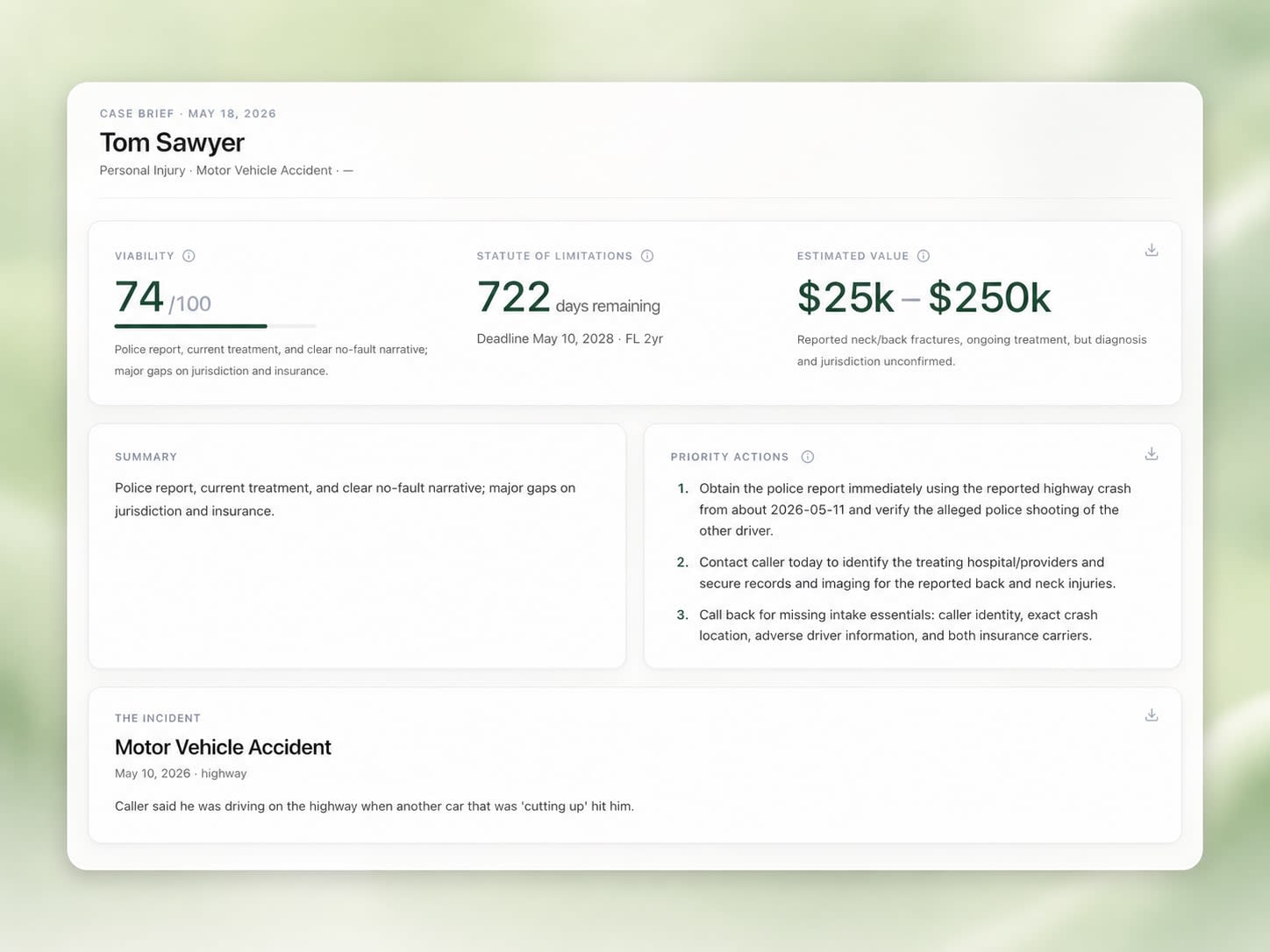
Score: 87. Surgery scheduled. Clear liability.

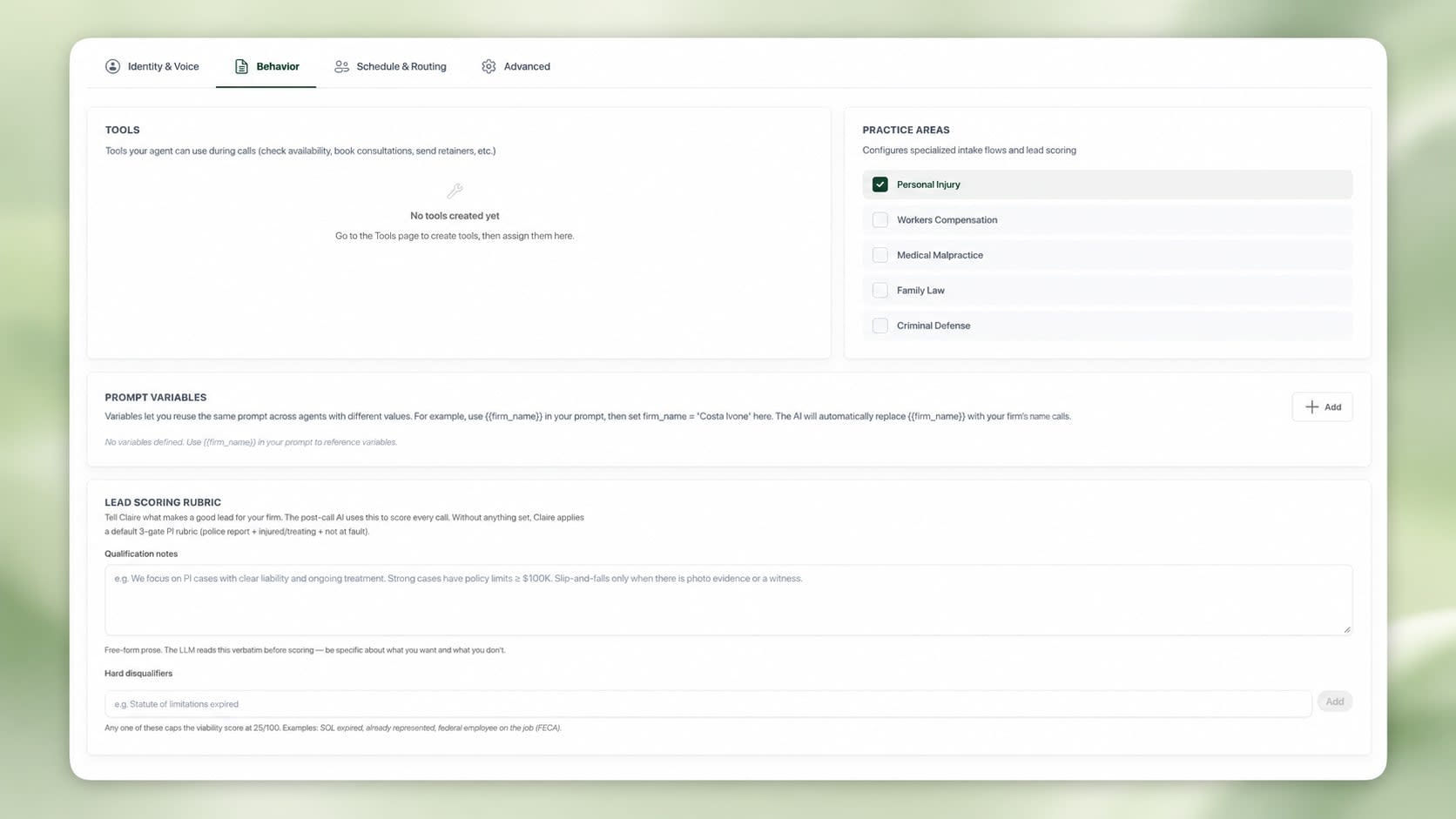
Not all leads are equal. Soft tissue with questionable liability? Score: 32. TBI with police report and $100K policy? Score: 94. You see the number before you open the file. High-value cases get routed to senior partners automatically.

Call ends. Lead appears in Filevine. 8 seconds.

Not "someone will enter it tomorrow." Not "check the shared inbox." In Filevine, Clio, Lead Docket—wherever you work. Full transcript attached. Injury details populated. SOL date calculated. Ready for your callback.

Comparative Data

Why Leading Firms Switch to ClaireAI

Quantifiable performance differences between autonomous AI infrastructure and traditional human-based answering services.

Performance Metric ClaireAI (Autonomous) Traditional Service
Avg. Response Time (Ring to Answer) < 0.2 Seconds ~45 Seconds (Variable)
Call Capacity (Concurrency) Infinite (Unlimited) 1 Call per Receptionist
Monthly Cost (Baseline) $650 Flat Rate $2.50 - $4.00 / minute
After-Hours / Weekend Coverage Included (24/7/365) Extra Fees / Shift Diff
Bilingual (English/Spanish) Native Fluency (Included) Often Unavailable / Premium
CRM Data Sync Speed Instant (< 100ms) Delayed (Manual Entry)

Data Source: 2025 Legal Intake Benchmark Report & ClaireAI Platform Metrics

Comparative Data

Why Leading Firms Switch to ClaireAI

Quantifiable performance differences between autonomous AI infrastructure and traditional human-based answering services.

Performance Metric ClaireAI (Autonomous) Traditional Service
Avg. Response Time (Ring to Answer) < 0.2 Seconds ~45 Seconds (Variable)
Call Capacity (Concurrency) Infinite (Unlimited) 1 Call per Receptionist
Monthly Cost (Baseline) $650 Flat Rate $2.50 - $4.00 / minute
After-Hours / Weekend Coverage Included (24/7/365) Extra Fees / Shift Diff
Bilingual (English/Spanish) Native Fluency (Included) Often Unavailable / Premium
CRM Data Sync Speed Instant (< 100ms) Delayed (Manual Entry)

Figure 1.1: Comparative Performance Analysis

Source: ClaireAI Platform Metrics (2025) & Legal Intake Benchmark Data (n=512 Firms)

REF: GEO-2026-v1

Every missed call is a case going to your competitor.

67%
Of PI callers call
another firm if no answer
$8,000
Average case value
lost per missed call
24/7
Accident calls captured
nights, weekends, holidays
MR

Maria Rodriguez

Received 2 min ago
High Value
87
Score
MVA - Rear End Collision
Case Value
$75-150k
Complexity
Moderate
Liability
Clear Fault
Insurance
$100k+ Policy
Treatment
Currently Treating
SOL Status
22 mo. remaining

Your paralegal gets a complete file. Not a sticky note.

  • "What insurance does the at-fault driver have?"

    We ask. Every time. Carrier name, policy limits, UM/UIM, MedPay—captured in the first call. Your paralegal isn't spending 2 hours chasing down details that should've been collected on day one.

  • Police report? Witnesses? Rear-ender? Flagged.

    Clear liability cases jump to the top of the queue. Your $25K state minimum soft-tissue gets a different priority than your $500K policy limits TBI with dashcam footage. We sort it automatically.

  • ER visit? Currently treating? Surgery scheduled?

    Treatment gap kills cases. We capture the timeline: when was the ER visit, who's the treating physician, what procedures are planned. Before your first callback, you know if the medical documentation will support the claim.

  • "Any prior injuries to your back?"

    Pre-existing conditions change everything. We ask—tactfully, conversationally—so you know what you're dealing with before the consult. No surprises when you request medical records.

Motorcycle wreck? Slip-and-fall? Different questions.

  • MVA: "Was the other driver cited?"

    Rear-end, T-bone, head-on, hit-and-run—each gets different follow-ups. Police report number, witness names, Uber/Lyft involvement, commercial truck carrier. 47 data points we capture that generic intake misses.

  • Premises: "Did they know about the hazard?"

    Wet floor, broken stairs, inadequate lighting, negligent security—each requires different evidence. We ask about incident reports, witnesses, prior complaints. Did Walmart clean up the spill? Did the landlord fix the railing? Premises liability lives or dies on notice.

  • Med-Mal: "Which hospital? When was the surgery?"

    These cases require more screening. Surgical complications, misdiagnosis, birth injuries—we capture the provider, facility, timeline, and what went wrong. Medical records requested? We ask. Expert review needed? We flag it. Your complex case intake doesn't get dumbed down.

  • Wrongful Death: Partner gets a text. Now.

    High-stakes cases don't wait for morning. When someone calls about a spouse killed by a drunk driver, Claire captures everything—relationship, dependents, circumstances—then immediately texts your senior partner. No queue. No delay.

Intelligent Routing

Case Type → AI Analysis → Qualified Lead

MVA
Slip & Fall
Med Mal
Wrongful Death
ClaireAI Smart Routing
Qualified
Liability Captured
Insurance Verified
Treatment Status
SOL Tracked

Intelligent intake for every injury type

Injuries ClaireAI Qualifies

Traumatic Brain Injuries & Spinal Cord

Identifies TBI symptoms, paralysis indicators, and long-term care needs for high-value catastrophic cases.

Broken Bones & Soft Tissue

Fractures, herniated discs, whiplash, torn ligaments. Captures treatment status and medical provider details.

Burns, Scars & Disfigurement

Documents severity, treatment history, and permanent damage for maximum case valuation.

Qualification Dashboard
Live
147
Cases
89
Qualified
$4.2M
Est. Value
MR
Maria Rodriguez
MVA - Rear End
87
SC
Sarah Chen
Medical Malpractice
94
JW
James Wilson
Slip & Fall
72
SOL Alert: Chen case expires in 45 days

PI firms capturing more cases with AI intake

Personal Injury Attorney
"We were losing cases every night and weekend. Since implementing ClaireAI, we've captured 47 additional signed cases in 6 months—all from after-hours calls we would have missed. The ROI is incredible."

— Managing Partner, Personal Injury Firm (Atlanta, GA)

47 New Cases in 6 Months
$2.1M Additional Revenue
Read the case study

Enterprise security for sensitive PI cases

Personal injury cases involve medical records, accident reports, and privileged communications. ClaireAI protects it all.

HIPAA Compliant

Full HIPAA compliance for medical information discussed during intake calls.

256-bit Encryption

All intake data encrypted at rest and in transit. Your cases are protected.

SOC 2 Type II

Annual audits verify our security controls meet enterprise standards.

Attorney-Client Privilege

Designed to protect privileged communications from the first call.

HIPAA Compliant
SOC 2 Type II
256-bit Encryption

Explore ClaireAI features

Discover how our AI-powered tools transform legal intake

Personal Injury Lead Generation with AI Intake

PI firms invest heavily in personal injury lead generation—Google Ads, LSAs, TV spots, billboards, radio. But all that spend is wasted when calls go unanswered. Someone who just got rear-ended isn't leaving a voicemail and waiting for a callback. They're calling the next firm on Google. AI intake ensures every lead gets captured regardless of when they call, so your marketing dollars actually convert.

Speed-to-lead is everything in personal injury. The first firm to respond wins the case more than 70% of the time. When a potential client describes their MVA to ClaireAI at 11 PM, the AI qualifies them, collects accident details, and books a consultation—all before your competitors even know the lead exists. By morning, you've got a signed retainer while they're still checking voicemails.

The math is straightforward: if you're spending $20,000 a month on advertising and missing 30% of resulting calls, you're flushing $6,000 down the drain every month. AI intake costs a fraction of that and captures every single lead.

How PI Attorneys Get More Leads with 24/7 Answering

Personal injury leads for attorneys don't arrive on a convenient schedule. MVA calls peak on weekends and during evening commute hours—exactly when most firms have gone home. Slip-and-fall incidents happen at all hours. Medical malpractice inquiries often come late at night, when patients finally have time to research their options after a long day at work. A personal injury attorney answering service needs to match this reality.

The data from our PI clients is clear: 42% of their qualified leads call outside business hours. For firms without 24/7 coverage, that's nearly half their potential caseload lost to competitors who pick up the phone. One trucking case at 2 AM can be worth more than a month of routine MVAs.

ClaireAI ensures no lead falls through the cracks. When someone calls about a car accident at midnight, the AI collects the same detailed intake information your staff would—then routes high-priority cases (catastrophic injury, wrongful death, commercial vehicle) for immediate attorney notification.

AI Intake Specialist for Injury Law

ClaireAI's AI handles PI-specific intake with the same depth as a trained legal intake specialist. It collects accident details—date, location, how it happened, who was at fault. It asks about injuries and current medical treatment status. It gathers insurance information for all parties involved. And it screens for statute of limitations issues that could affect case viability.

High-value cases get special treatment. When ClaireAI identifies a potential catastrophic injury—spinal cord damage, traumatic brain injury, wrongful death—it triggers immediate SMS and email alerts to your intake coordinator or managing partner. These cases don't wait in a queue. They get reviewed while the lead is still warm and before they've had time to call another firm.

Every call gets logged in your CRM with a complete transcript, lead score, and recommended next steps. Your team starts each day with a prioritized list of qualified leads, not a backlog of voicemails to transcribe.

PI Intake Best Practices: What Top Firms Do Differently

We've worked with PI firms ranging from solo practitioners to 50-attorney powerhouses. The top performers share intake habits that others overlook:

They answer every call live. Sounds obvious. It isn't. The average PI firm sends 35% of calls to voicemail. Top firms answer 100%—even at 3 AM, even on Christmas. The math is simple: 35% of missed calls times average case value times conversion rate equals money left on the table.

They qualify aggressively. Not every call is a case. Good intake filters out the people who want advice but won't hire, the cases that happened in other states, the incidents that clearly lack liability. Your attorneys should spend time on qualified leads, not listening to twenty-minute stories from people who ultimately need someone else.

They route high-value cases immediately. A catastrophic injury call at 10 PM shouldn't sit in the queue until morning. Top firms configure their intake to identify big cases—commercial vehicle accidents, severe TBI, wrongful death—and push those to senior partners or intake coordinators in real time.

They track everything. Call volume by hour. Conversion rates by lead source. Time from initial call to signed retainer. You can't improve what you don't measure. The firms that dominate their markets know their numbers cold.

After-Hours Personal Injury Lead Capture

Accidents don't stop at 5 PM. Neither should your intake.

Here's what after-hours PI intake actually looks like: 6:47 PM on a Thursday, someone rear-ended during their commute home. They're sitting in urgent care, phone in hand, Googling "car accident lawyer." They call three firms. Yours picks up—AI, sounds natural, asks the right questions. Theirs go to voicemail. By the time their staff checks messages Friday morning, you've already collected full incident details, booked a Monday consultation, and sent a follow-up text.

Weekends are even more pronounced. Saturday afternoon fender-benders. Sunday night DUI-related crashes. The callers are anxious, they want to talk to someone now, and whoever answers first has a massive advantage. We've seen firms increase weekend case volume by 200-300% simply by implementing 24/7 answering.

The alternative—voicemail—just doesn't work anymore. 67% of people won't leave a message. They hang up and call the next firm. Your expensive LSA click, your hard-won Google ranking, your billboard that finally got someone's attention—all wasted because nobody picked up the phone.

How ClaireAI Qualifies Personal Injury Cases

ClaireAI doesn't just answer calls—it qualifies leads using the same criteria your best intake coordinator would. Here's the flow:

Incident details: What happened? When? Where? Who was at fault? The AI collects this conversationally, not like a robot reading a checklist. It knows to ask about police reports, witness information, and whether the other driver admitted fault.

Injury assessment: What injuries did you sustain? Have you seen a doctor? Are you still treating? This information drives case value estimates and helps prioritize leads.

Insurance status: Who was the at-fault driver insured with? Policy limits if known? This determines potential recovery and helps identify coverage issues early.

Lead scoring: Based on all collected information, ClaireAI assigns a priority score. Catastrophic injuries with clear liability and good insurance get flagged for immediate attention. Minor impacts with disputed liability go to the standard queue.

Everything syncs to your CRM—Clio, Filevine, SmartAdvocate, whatever you use. By the time you review the lead, you have a complete picture: contact info, incident summary, injury description, insurance details, lead score, and full call transcript.

Common questions about PI intake

Caller describes their accident. AI listens, asks the right follow-ups (injury type, treatment status, insurance info), and qualifies against your criteria. Everything syncs to your CRM with a lead score before you've finished your coffee.

Pretty much all of them: MVA, motorcycle, truck, pedestrian, slip-and-fall, med mal, product liability, workplace injuries, dog bites, premises liability, wrongful death. The AI adjusts its questions based on the specific injury type—a trucking case gets different follow-ups than a slip-and-fall.

The system captures the accident date during intake, calculates the applicable deadline based on your state and case type, and flags anything approaching the window. You'll get alerts at 90, 60, and 30 days out. We built this after talking to a firm that lost a case worth six figures because someone wrote down the wrong date on a sticky note.

Yes—based on your criteria, not ours. Injury severity, liability clarity, insurance coverage, treatment status. High-value leads get flagged for immediate follow-up. You can route them to specific attorneys if you want.

$650/month for 150 calls. $1,250/month for 500. Enterprise is $2,999/month for unlimited. All plans include 24/7 intake, PI qualification, SOL tracking, CRM sync, and bilingual support. Most firms hit positive ROI within the first month—one additional case typically covers 6-12 months of service.

Somewhere right now, someone just got rear-ended. Will you answer?